
California Adaptation Planning Guide (APG)
The California Adaptation Planning Guide (APG) is designed to support local government, regional organizations, and climate collaborative groups to integrate best practices and current science into their adaptation planning efforts. The APG provides helpful resources to local governments as they comply with state requirements for local adaptation planning, and provides recommendations and advice on community-level climate change adaptation planning.
For questions, contact: APG@CalOES.ca.gov
Public Comment Period Now Closed
The public comment period for the draft 2026 California Adaptation Planning Guide (APG) closed on September 9, 2026. Thank you to everyone who provided feedback, submitted comments, and participated in our public and Tribal engagement workshops.
About This Update
Cal OES is pleased to announce that the California Adaptation Planning Guide is being updated. The goal is to make this guidance a more robust public resource for local and Tribal governments across the state.
As part of our commitment to Senate Bill 246 (SB 246), and in response to the 2024 Climate Adaptation Strategy update, Cal OES, in partnership with the Governor’s Office of Land Use and Climate Innovation (LCI) and the California Natural Resources Agency (CNRA), is revising the guidebook to better support communities across the State.
Next Steps & Timeline
During Fall 2026, the project team and partner agencies will review all public and workshop input. These insights will inform the Final 2026 Adaptation Planning Guide, scheduled for official publication in December 2026.
Resources
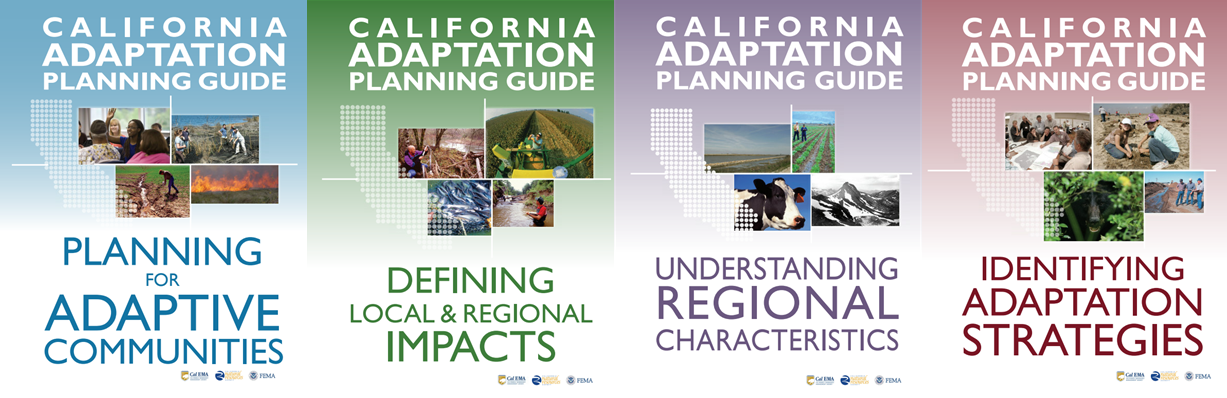
Original 2012 California Adaptation Planning Guide
Released in 2012 by Cal OES in collaboration with state agencies, universities, and local experts, the original APG marked California’s first local framework for climate adaptation planning. It established a structured, step-by-step process for assessing climate vulnerability and developing local adaptation strategies in response to unavoidable climate impacts.
Equity and community outreach were incorporated throughout, reflecting an early emphasis on inclusive and participatory climate adaptation planning in California. The 4 parts are listed below:
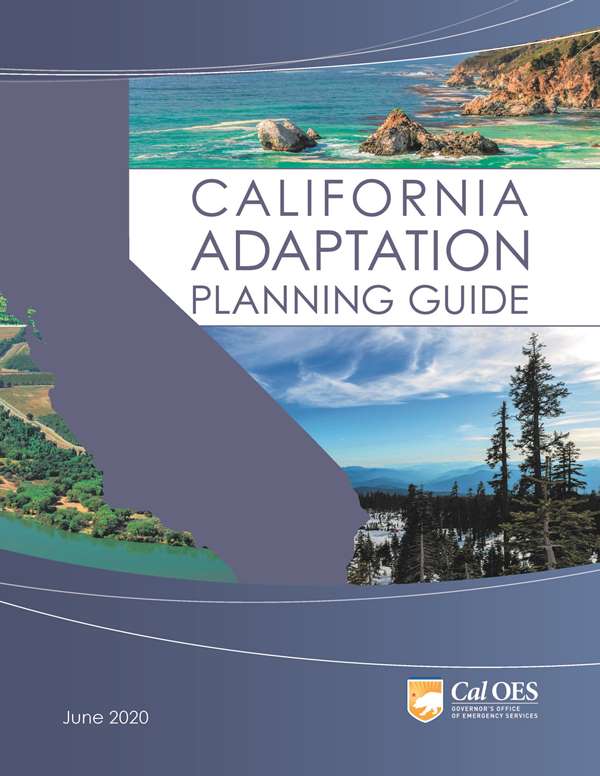
CLICK HERE TO SEE THE 2020 PLAN
Since its original release in 2012, the APG has provide local, Tribal, and regional governments in California with practical guidance, tools, and strategies to support climate adaptation planning, including coordinating across jurisdictions, understanding climate impacts, conducting vulnerability assessments, engaging communities, improving public safety, and identifying actions to reduce climate-related risks.

Integrated Climate Adaptation and Resiliency Program (ICARP)
ICARP houses the following and more:
- Adaptation Clearinghouse: Serves as California’s centralized hub for adaptation resources
- Cal-Adapt: Offers tools and datasets to help assess local climate change impacts and supports data-driven decision-making
- Vulnerable Communities Platform: Local governments and CBOs can use the VCP to identify frontline communities most vulnerable to climate change impacts, to inform climate adaptation planning and outreach
California Climate Adaptation Strategy
The California Climate Adaptation Strategy, formerly known as the Safeguarding California plan is California’s overarching framework for building community, economic, and environmental resilience to climate impacts, such as fire, floods, heat, drought, and sea level rise. It reflects key pillars of sector or threat-specific efforts, showing how they fit together and drive us toward California’s six climate resilience priorities.
These resilience priorities are California’s climate adaptation “north stars” – they guide the state’s collective efforts, connect the dots across sector-specific work, and reflect the outcomes we seek to achieve. The Strategy was called for in Assembly Bill 1482 (Gordon, 2015), which also requires it to be updated every three years. Under Senate Bill 246, Cal OES is required to update the APG each time a new Climate Adaptation Strategy is released. CNRA’s most recent release is the 2024 California Climate Adaptation Strategy.

California Climate Change Assessment
California’s Climate Change Assessments contribute to the scientific foundation for understanding climate-related vulnerability throughout California. They provide extensive, research-based information on climate impacts and vulnerabilities statewide. Its last version was published in 2024 and will next be published in 2026.

California State Hazard Mitigation Plan (SHMP)
The SHMP outlines California’s hazard risks, efforts to reduce future disaster losses, and statewide mitigation strategies. Maintaining a FEMA-approved plan ensures California remains eligible for federal mitigation and disaster recovery funding programs. Its last version was published in 2023 and will next will be release in 2028.
Annika Braucher, Plan Lead
Email: Annika.Braucher@CalOES.ca.gov, APG@CalOES.ca.gov
State Hazard Mitigation Planning Unit, Hazard Mitigation Section, Recovery Directorate